Featured project
Back to workRDR Tech
Real-time workflow ops for audit & tax teams
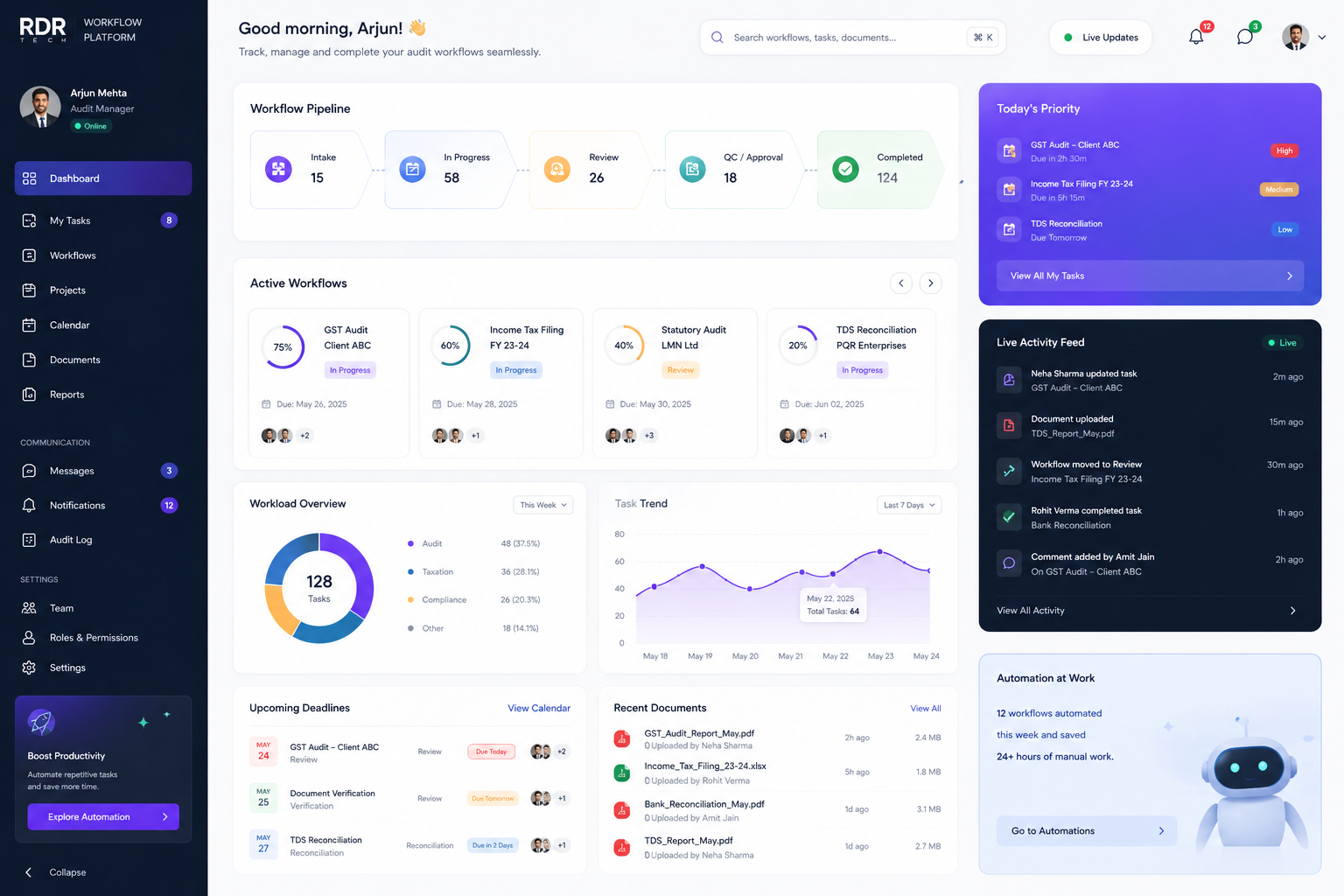
01 — Overview
Web dashboards, task workflows, and WebSocket updates — separate from the mobile client.
RDR Tech on the web is the production workflow platform. The RDR Tech App is a separate mobile client documented under Mobile Applications.
02 — Problem
The product had to hold up as a connected workflow.
Professional-services teams needed a web product where workflow progress, assignments, and reporting stayed current for every user in real time.
03 — My role
What I owned.
Frontend Product Engineer — Frontend Product Engineer on the RDR Tech web client — workflow UI, dashboards, real-time state, and API integration. I owned frontend and UI/UX; backend was handled separately, and I contribute there when needed.
04 — Product flow
The path a user actually takes.
I treated the web client as the live operations layer — workflow state, dashboards, and actions had to stay synchronized as users worked in parallel.
Conceptual product flow for this domain — not a literal system diagram.
05 — Engineering
Decisions worth explaining.
Use WebSockets for workflow synchronization instead of manual refresh.
Model workflow permissions in the UI, not just on the server.
Keep reporting and task views modular but consistent.
05.1 — Architecture
How the pieces sit together.
06 — Challenges
What shaped the build.
Real-time workflow synchronization
Multiple users needed to see task and workflow changes without manual refresh, requiring WebSocket-driven UI updates.
Role-aware workflow states
Different roles could perform different actions at each workflow stage, so the UI had to reflect permissions and valid transitions clearly.
Dense operational dashboards
Reporting and workload views needed to present complex operational data without overwhelming users.
Concurrent updates
Live collaboration on workflow data required predictable UI behaviour when multiple users acted at the same time.
07 — Outcome
What shipped.
Production
Production web application for internal company use — not publicly available.
Qualitative — no performance or business metrics are claimed here.
A real-time web operations platform for audit and taxation workflows, with live dashboards and role-aware task management.
Production web workflow platform used internally by the company — not publicly available. Mobile companion app is documented separately under RDR Tech App.
In the product
React and TypeScript web application
WebSocket-driven live updates
REST API integration with Node.js services
Role-based workflow UI
Chart-based operational dashboards
Task assignment and approval flows
Document management interfaces
Worked with the Node.js backend and real-time event lifecycle; backend service ownership is not claimed from the frontend repository.
08 — Learnings
I treated the web client as the live operations layer — workflow state, dashboards, and actions had to stay synchronized as users worked in parallel.